Key takeaways
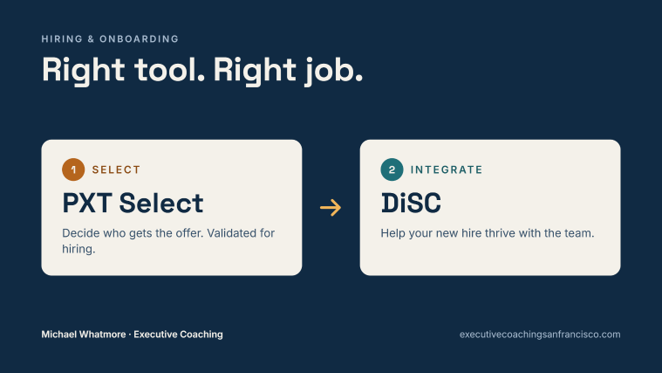
- Assessments do two different jobs: selecting who to hire and then integrating the person you hired.
- Use a tool that is confirmed for hiring, such as PXT Select, plus structured interviews, and work samples.
- Wiley, the publisher of DiSC, does not recommend DiSC for pre-employment screening.
- After the offer, DiSC helps your new hire and your team communicate and work well together.
Hiring is one of the most important things you do as a leader. It is also one of the easiest to get wrong.
For many business owners, hiring is also one of the most feared tasks. Every new employee is an investment of time and money: recruiting, interviewing, onboarding, and training.
That investment keeps growing. In its 2025 benchmarking survey, the Society for Human Resource Management (SHRM) put the average cost per hire at $5,475 for nonexecutive roles and $35,879 for executive roles.
These costs cover only the filling the seat. A wrong choice means a bad hire that costs far more: lost productivity, a disrupted team, even a sudden departure, and a search that starts over.
Employee assessment tools can help you get it right the first time, as long as you use the right tool for the right job. That is where many leaders go wrong.
Assessments Do Two Different Jobs
Many leaders treat “assessment” as a single initiative. In practice, assessments serve two very different functions:
- Selecting: deciding who gets the job offer, in other words “who is the best fit?”
- Integrating: helping the person you hired succeed with your team.
Mistaking those two functions as one in the same, is the most common, and most avoidable, mistakes I see.
Job One: Selecting the Right Person
How does Job Fit work?
There are many tools to help organizations learn about their candidates, examples include resumes, structured interviews, work samples, and background checks. All of these focus on past or current behavior. None provide a comprehensive look at predicting an individual’s future performance in a given role.
The best tools used at this stage must be confirmed and validated for hiring. That means research shows they predict a candidate’s success in a specific role, such as hiring-specific assessments such as PXT Select which I offer as a PXT Select distributor.

Why DiSC doesn’t belong in your hiring decision
This distinction comes straight from Wiley, the publisher of Everything DiSC. Wiley states that DiSC is not recommended for pre-employment screening, because it does not measure the skills or aptitudes a specific position requires.
DiSC describes how a person naturally prefers to work and communicate. It is not a pass-or-fail test. For selection, Wiley recommends PXT Select instead, which it has validated for hiring.
There is a legal reason to respect this line, too. The U.S. Equal Employment Opportunity Commission (EEOC) advises employers that any test used to screen applicants should be validated for the job and the purpose it is used for. If you are unsure whether a tool meets that standard, check with your HR advisor or employment attorney before using it in hiring.
| At a glance | PXT Select | Everything DiSC |
| Use it to | Decide who gets the offer | Help your new hire work well with the team |
| When | Before the offer | After the offer: onboarding and teamwork |
| Validated for hiring? | Yes | No, per Wiley |
Job Two: Integrating Your New Hire. This Is Where DiSC Shines
Once you have made your hire, a DiSC profile gives you a practical map of how your new team member works. DiSC stands for Dominance, Influence, Steadiness, and Conscientiousness. We all show these styles to varying degrees.
A DiSC report helps you understand how this person prefers to communicate, how they are likely to respond under pressure, and how to give them feedback they will actually hear.
With the results in hand, ask yourself:
- How will this person work alongside our current staff?
- What can I do to help them integrate into the organization?
- How can I help others include this individual in their workflow?
- What adjustments might my current team make so everyone works well together?
How to Introduce DiSC to a New Team Member
Some people feel uneasy about personality assessments. They may wonder, “What will this reveal about me? Will it expose my weaknesses?”
Be clear and reassuring:
- Explain that DiSC has no right or wrong answers and no bearing on their job.
- Tell them its only purpose is to help the team communicate better and work together more effectively.
- Be specific about who will see the results.
- Let them decide whether to share their profile with colleagues.

Read the Results Without Bias
It takes discipline as a leader to avoid bias. Use the results to understand people, not to judge or rank them. A style is not a strength or a weakness, and every style brings something your team needs.
A certified DiSC facilitator can help you interpret profiles and apply them well. Used carelessly, any assessment can create labels that box people in.
Bring Your Whole Team Into the Conversation
DiSC is most powerful when the whole team takes part. When team members choose to share their profiles, I ask questions like:
“Knowing how each of us works, how should we approach problem-solving and planning together? What would help each of us do our best work?”
These conversations help a new hire find their footing quickly. They also give you an excellent opportunity to coach your entire team.
The Bottom Line
Select with validated tools. Integrate with DiSC.
Use validated tools and structured interviews to choose the right person. Then use DiSC to help that person, and everyone around them, communicate and perform at their best. Together, they help you build a team that moves your vision forward.
Frequently Asked Questions
Should I use DiSC to make hiring decisions?
No. Wiley, the publisher of Everything DiSC, does not recommend DiSC for pre-employment screening, because it does not measure the skills or aptitudes a specific position requires.
What is PXT Select used for?
PXT Select is a hiring assessment from Wiley, confirmed for selection. Use it alongside structured interviews and work samples to decide who gets the offer.
When should I use DiSC with a new employee?
After the hire. DiSC helps you and your team understand how the new person prefers to communicate and work, so they can integrate faster.
What does DiSC stand for?
Dominance, Influence, Steadiness, and Conscientiousness. Everyone shows all four styles to varying degrees.
Ready to hire, and onboard, with confidence?
Want to see how PXT Select and DiSC can work together in your hiring and onboarding? Schedule a conversation with Michael